How to Start Writing Fiction: A Beginner's Guide to Your First Story
Why Fiction Writing Is Worth Starting Today
Fiction writing is one of the most accessible creative skills a person can develop — and you don't need talent, a degree, or a "gift" to begin. What you need is the decision to start.
Most people who want to write fiction spend years waiting for the right moment, the right idea, or enough confidence. That moment rarely arrives on its own. The writers who actually finish stories are not the most naturally gifted — they're the ones who sat down and wrote badly at first, then kept going.
There's also something uniquely rewarding about fiction specifically. You get to invent people, places, and problems. You control what happens. And when a story lands — even a short one — the feeling of having built something from nothing is hard to match.
If you've ever thought "I have a story in me somewhere," that thought is reason enough to start today.
Choose Your Story Idea (Without Overthinking It)
The best story idea for a beginner is the one that makes you curious enough to keep writing. It doesn't need to be original, profound, or marketable — it just needs to hold your attention.
One of the most effective techniques is the "what if" question. Take something ordinary and push it sideways: What if a librarian discovered every book she touched revealed the reader's last secret? What if two strangers kept missing each other by exactly one minute, every day for a year? These questions don't require elaborate world-building — they just need a spark.
Writing prompts are another reliable entry point. A single image, an overheard conversation, or a prompt like "write about a door that shouldn't be there" can bypass blank-page paralysis entirely. The prompt isn't the story — it's just the ignition.
Personal experience also works well. You don't need to write autobiographically, but emotions you've actually felt — grief, embarrassment, unexpected joy — give your fiction an authenticity that's difficult to fake. Take a real feeling and build a fictional situation around it.
The trap beginners fall into is waiting for the "perfect" idea. There isn't one. Pick something that interests you right now and start there.
Understand the Basic Building Blocks of Fiction
Every piece of fiction, from a two-page short story to a thousand-page novel, is built from the same core elements: character, conflict, setting, and plot. Understanding these doesn't require a literature degree — just a working sense of how they fit together.
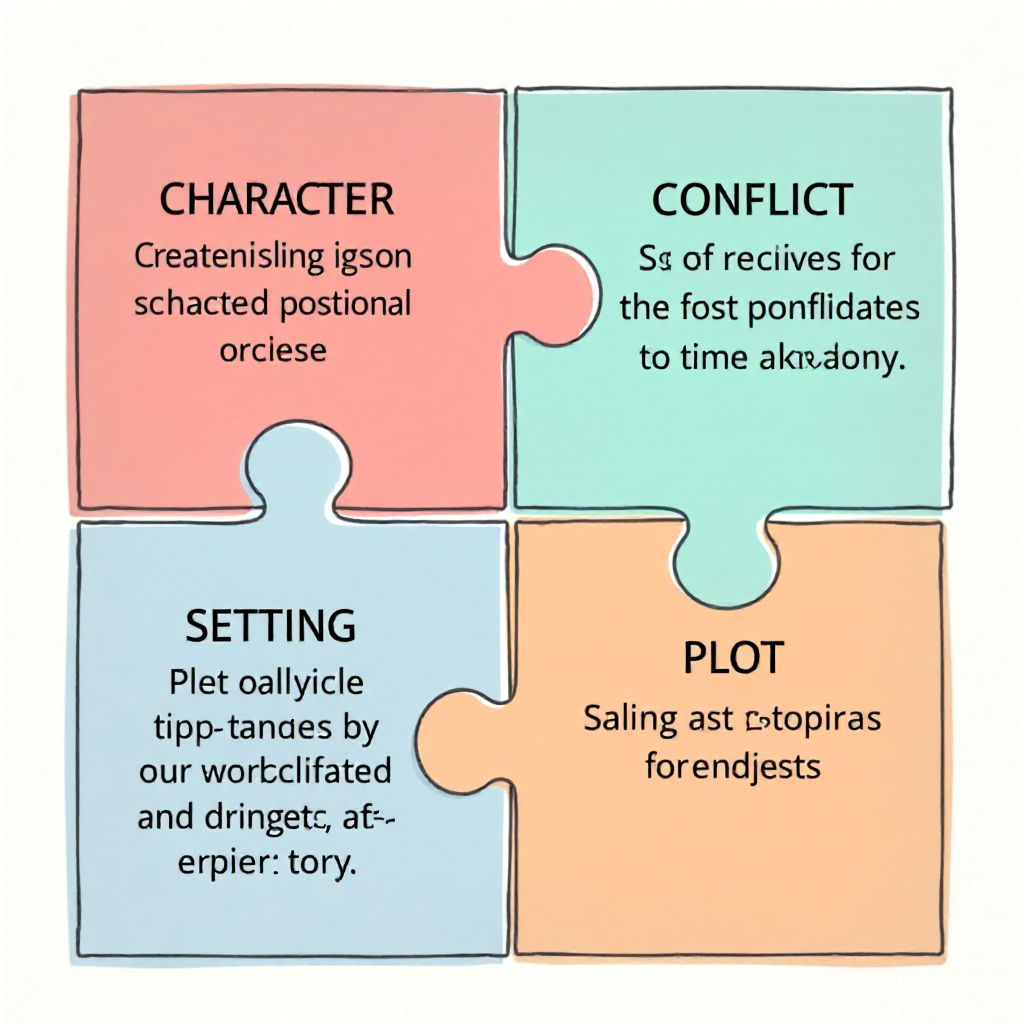
Character
Character development is often where the most memorable fiction lives. Your protagonist doesn't need to be likable, but they need to want something — and that desire should feel real. Give your character a specific flaw, a specific goal, and a specific voice. Readers follow characters, not plots.
Conflict
Conflict is the engine that drives every story forward. Without it, nothing happens. Conflict doesn't always mean fighting — it means a gap between what your character wants and what they have. That gap creates tension, and tension keeps readers turning pages. Internal conflict (a character struggling with a decision) is just as powerful as external conflict (a character struggling against another person or situation).
Setting and World-Building
Setting is where and when your story takes place. For realistic fiction, this might be a specific city or era. For genre fiction — fantasy, science fiction, horror — world-building becomes more involved, but beginners should resist the urge to over-engineer it. Build what the story needs, not everything you can imagine. The setting should feel lived-in, not exhaustively documented.
Plot Structure
Plot structure is simply the sequence of events that moves your story from beginning to end. A basic three-act shape — setup, confrontation, resolution — is enough to get started. You don't need a 27-point outline. You need a beginning that establishes something, a middle where things get complicated, and an ending that resolves (or deliberately leaves open) the central tension.
Pick the Right Format to Start: Short Stories vs. Novels
For beginners, the short story is almost always the right starting format. A short story lets you practice every element of fiction — character, conflict, plot, point of view — within a scope you can actually finish.
Novels are seductive because they feel more "serious," but they're also punishing for first-time writers. Most abandoned manuscripts are abandoned novels. The writer runs out of momentum, loses the thread, or realizes the structure is broken at chapter seven with no idea how to fix it.
A short story — even one between 1,000 and 5,000 words — teaches you how stories work from the inside. You learn how to open with tension, how to pace a scene, how to land an ending. Those lessons transfer directly to longer work when you're ready.
Think of the short story as a complete workout, not a warm-up. Many of the most respected writers in literary history — Chekhov, Flannery O'Connor, Alice Munro — built entire careers on short fiction alone.
How to Write Your First Draft Without Stopping
Your first draft has one job: to exist. It doesn't need to be good. It needs to be written.
This is the hardest mindset shift for beginners. The instinct is to write a sentence, hate it, delete it, and write it again. That loop kills momentum and produces nothing. The better approach is to write forward — keep moving even when the sentences feel wrong, even when you're not sure what happens next, even when you suspect the whole thing is terrible.
A few things that help:
- Turn off spell-check and autocorrect while drafting — they interrupt flow
- Set a small, specific goal ("I'll write 300 words today") rather than a vague one ("I'll write when I feel inspired")
- Give yourself permission to write placeholder notes like [fix this later] and keep going
- Don't reread yesterday's pages before starting today's — it pulls you into editing mode
Point of view is one decision worth making before you draft rather than during it. First-person POV ("I walked into the room") is often easiest for beginners — it's intimate and immediate. Third-person limited ("She walked into the room") gives you slightly more flexibility. Switching POV mid-draft creates confusion that's painful to untangle later.
The first draft is a private document. No one has to see it. That freedom is real — use it.
Build a Writing Habit That Actually Sticks
A consistent writing habit matters more than any single session of inspiration. Inspiration is unreliable; a scheduled habit is not.
The most common mistake beginners make is waiting until they "have time" to write. That time doesn't appear on its own. It has to be carved out deliberately, even if it's only 20 minutes a day.
A few principles that work in practice:
- Write at the same time each day — morning tends to work well because the day hasn't accumulated its friction yet, but the best time is whatever you'll actually protect
- Start with a tiny commitment — even 200 words a day adds up to a complete short story draft in two weeks
- Keep your work-in-progress file open and visible, not buried in a folder — friction kills habits
- Track your streak, not your word count — consistency matters more than volume at the start
Don't try to build the perfect writing environment before you start. You don't need a dedicated office, a specific notebook, or the right music. You need a device and a decision.
What to Do After Your First Draft Is Done
Finishing a first draft is a real achievement — most people who say they want to write never get there. Once you have one, the next step is revision, which is a separate process from drafting and requires a different mindset.
Wait at least a few days before rereading your draft. Distance helps you see what's actually on the page rather than what you intended. When you do return to it, read it through once without changing anything — just note what's working and what isn't.
Revision isn't about fixing typos. It's about asking whether the story does what you wanted it to do. Does the conflict feel real? Does the ending earn its resolution? Is the character someone a reader would follow? These questions are harder than grammar, but they're the ones that matter.
When you feel the story is ready, consider sharing it. Trusted friends, writing groups, or online communities for fiction readers and writers can offer perspective you can't get from rereading your own work. Sharing is uncomfortable the first time — and genuinely useful.
Most importantly: start your next story. The writers who improve fastest are the ones who finish things and move on, not the ones who polish a single piece indefinitely. Every story you complete teaches you something the previous one couldn't.
Frequently Asked Questions
How long should a beginner's first story be?
Aim for 1,000 to 3,000 words for your first attempt. That range is short enough to finish quickly but long enough to practice the full arc of a story — setup, conflict, and resolution. Don't worry about hitting a specific number; focus on completing the narrative.
Do I need to outline my story before I start writing?
No — and for beginners, a rigid outline can sometimes become another form of procrastination. A loose sense of where your story is going (beginning, a central complication, a rough ending) is enough. Some writers discover their story by writing it. Try both approaches and see which keeps you moving.
What if my writing feels bad — is that normal?
Completely normal. Every writer's first drafts are rough — including writers whose published work you admire. The feeling that your writing is bad doesn't mean it is; it often means your taste is ahead of your current skill, which is exactly the gap that practice closes. The only writing that stays bad is writing that stops.
Can I write fiction if I don't read much?
You can start, but reading fiction will accelerate your growth faster than almost anything else. Reading teaches you story structure, pacing, dialogue, and voice in a way that no craft guide fully replicates. You absorb technique without realizing it. If you want to write fiction seriously, Project Gutenberg offers thousands of classic works for free — a practical place to start reading widely.
Where can I share my fiction stories online?
Online fiction communities are a good first step — look for platforms and forums dedicated to short fiction, creative writing, and reader feedback. Sharing your work with an audience, even a small one, builds accountability and gives you a reason to finish. Many writers find that the habit of publishing regularly — even informally — improves their output more than any other single practice.